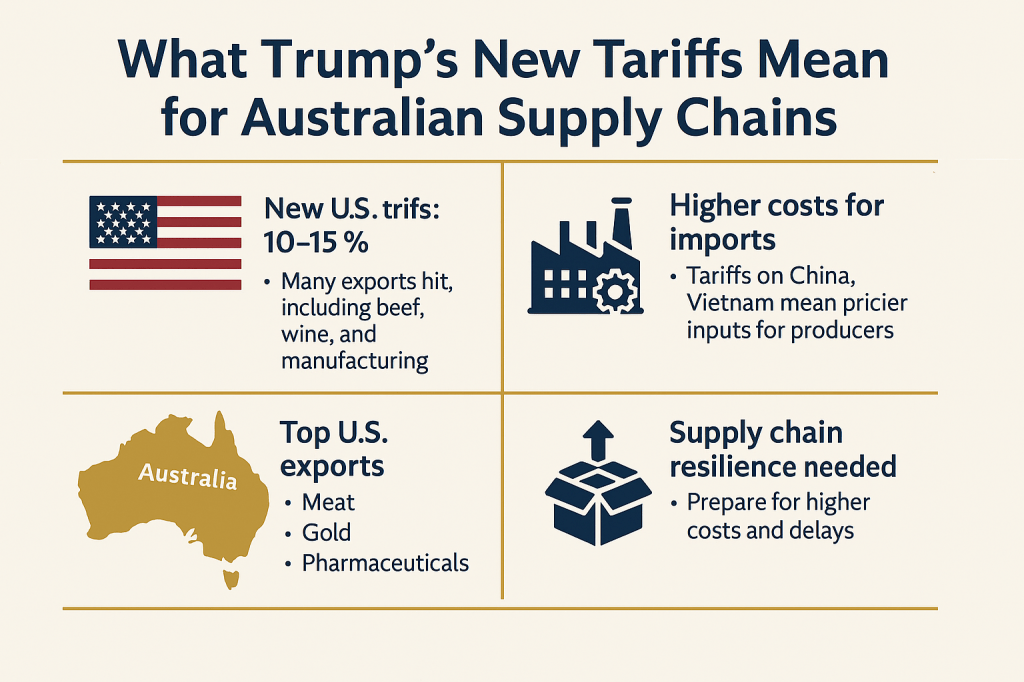
The United States has entered a new era of tariff policy, and Australia is feeling the ripple effects. In February 2026, the U.S. Supreme Court struck down many of former President Donald Trump’s earlier tariffs, ruling that he had exceeded his authority under the International Emergency Economic Powers Act (IEEPA). But the relief was short‑lived. Within hours, Trump replaced the invalidated tariffs with a new universal import tariff, using a different law — Section 122 of the Trade Act of 1974, which allows temporary tariffs of up to 15% for 150 days. [bcec.edu.au] [cbsnews.com]
For Australian exporters and supply‑chain operators, this adds another layer of unpredictability to an already volatile global environment. These tariffs affect not only exports directly entering the U.S. but also Australia’s inbound supply chains due to upstream disruptions in Asia.
This article explains the changes, the impacts on Australian businesses, and how organisations can strengthen resilience using Conduit Consulting’s supply‑chain diagnostics and network‑design tools.
1. What Changed — and Why It Matters
The Supreme Court resets the board
In February, the U.S. Supreme Court ruled 6–3 that Trump’s signature tariffs imposed through IEEPA were illegal because the law does not give the president the power to impose duties — that remains Congress’ job. This invalidated many steep levies introduced in 2025. [bcec.edu.au]
Trump reacts immediately with new tariffs
Trump swiftly invoked Section 122, a rarely used law allowing a global import tariff for a short period when the U.S. faces a balance‑of‑payments issue. He introduced a new 10% tariff, then signalled it would rise to 15%, the legal maximum. [abc.net.au]
Crucially:
- The tariff applies to all countries, including Australia.
- It lasts 150 days unless Congress extends it.
- It sits on top of existing sector‑specific tariffs that remain in place.
Sector‑specific tariffs still apply
Tariffs on steel, aluminium (50%), autos (25%), and copper products (50%) remain intact because they were introduced under a different law (Section 232) and were unaffected by the Court ruling. [cnbc.com]
eCommerce gets hit too
The U.S. has permanently suspended the de minimis exemption, meaning parcels under US$800 are no longer duty‑free — a major blow for Australian retailers shipping directly to U.S. consumers. [nbcnews.com]
2. How This Affects Australian Exporters
A. Australian goods suddenly cost more in the U.S.
The new universal tariff lifts the landed cost of most Australian exports by 10–15%, affecting:
- Beef
- Wine
- Gold
- Pharmaceuticals
- Machinery
- Apparel and consumer goods
Australian businesses have reported significant and sometimes seven‑figure tariff bills after earlier rounds of U.S. policy shifts. [cnbc.com]
B. Pharmaceuticals are bracing for even bigger blows
Beyond the universal tariff, the Trump administration has floated tariffs of 150–250% on pharmaceuticals over the next 18 months. With Australia exporting more than $2b worth of medicines to the U.S. annually, the life‑sciences sector is particularly exposed. [bdo.com.au]
C. Manufacturers face pricier inputs
Australian manufacturers often rely on components from China, Vietnam and Japan — all heavily targeted by U.S. tariffs. This raises international prices and causes supply‑chain delays that flow directly into Australian operations. [cnbc.com]
D. China’s slowdown affects Australian commodities
Around 40% of Australian exports go to China, especially iron ore. If China’s manufacturing industry slows due to U.S. trade pressure, Australian commodity demand is likely to weaken. [dfat.gov.au]
3. Sector‑by‑Sector Snapshot
Agriculture
Beef, lamb, horticulture, dairy and wine now face increased difficulty entering the U.S. market competitively. A 15% uplift on price can push products off supermarket shelves in favour of local alternatives.
[theoasisre…orters.com]
Metals & Resources
Australia’s aluminium, steel and copper supply chains are directly affected by sector‑specific tariffs of up to 50%.
[cnbc.com]
Pharmaceuticals
The combination of universal tariffs and proposed 150–250% penalties could dramatically reshape Australia’s largest medical export category.
[bdo.com.au]
Retail & eCommerce
D2C brands now lose cost advantages due to the removal of duty‑free parcel thresholds.
[nbcnews.com]
Manufacturing
Global component shortages and cost inflation are expected to continue as upstream Asian suppliers face U.S. trade pressure.
[cnbc.com]
4. What Australian Businesses Should Do Next
1. Map your tariff exposure
Businesses must quantify:
- Which products face the new 10–15% tariff
- Which products face additional sector‑specific tariffs
- How these costs affect margin and pricing
How Conduit helps:
Our Supply‑Chain Diagnostics platform runs a Tariff Stress Test, identifying:
- SKU‑level exposure
- Margin erosion
- Refund eligibility (for previous illegal tariffs)
- Product‑level opportunities for reclassification or repricing
2. Rethink your logistics network
With Section 122 tariffs limited to 150 days, timing logistics matters. Australian exporters can:
- Pre‑ship before tariff increases
- Delay non‑essential exports until after tariff expiry
- Use U.S. 3PL hubs or bonded warehouses
- Shift to lower‑congestion ports (e.g., Houston instead of LA)
Freight disruption is already visible, especially around U.S. West Coast ports. [cnbc.com]
Conduit Network Design Tools
We model:
- Optimal U.S. distribution locations
- Alternative port combinations
- Sea vs air cost trade‑offs under tariff conditions
- Safety‑stock strategies for a volatile tariff cycle
3. Diversify suppliers and build redundancy
Australian manufacturers reliant on Chinese or Vietnamese inputs should consider:
- Dual‑sourcing strategies
- Qualifying secondary suppliers in ASEAN or Europe
- Building buffer stock to mitigate short-term volatility
Diversification reduces exposure to geopolitical risk.
[cnbc.com]
4. Prepare for the possibility of refunds
Because many earlier tariffs were ruled unlawful, businesses may be entitled to refunds — but only if documentation is airtight.
[uhy-us.com]
Exporters should retain:
- Tariff payment records
- Invoices and customs filings
- HTS codes and product descriptions
Conduit can assemble refund readiness packs through our diagnostics platform.
5. Stay engaged with government and industry
Bodies like DFAT, Austrade, ACCI and Ai Group are actively providing updates on:
- Exemptions
- New tariff investigations
- Policy interpretations
[cnbc.com], [nbcnews.com], [cfr.org], [australiatimes.com]
Businesses should appoint an internal tariff lead or work with advisors to stay ahead of changes.
5. The Bottom Line
Trump’s new tariffs introduce cost pressures and uncertainty for Australian exporters, suppliers, manufacturers and eCommerce sellers. While the universal 15% tariff may expire within months, the U.S. is simultaneously initiating new sector‑specific investigations that could prolong or expand tariff exposure.
Australian businesses that take proactive steps — mapping risk, redesigning networks, diversifying suppliers and preparing for refunds — will be far better positioned than those who simply “wait and see.”
Conduit Consulting’s supply‑chain diagnostics and network design tools are purpose‑built for this kind of volatile environment, helping organisations protect margins, support customers and maintain competitiveness.
 Conduit Consulting Services
Leave a comment